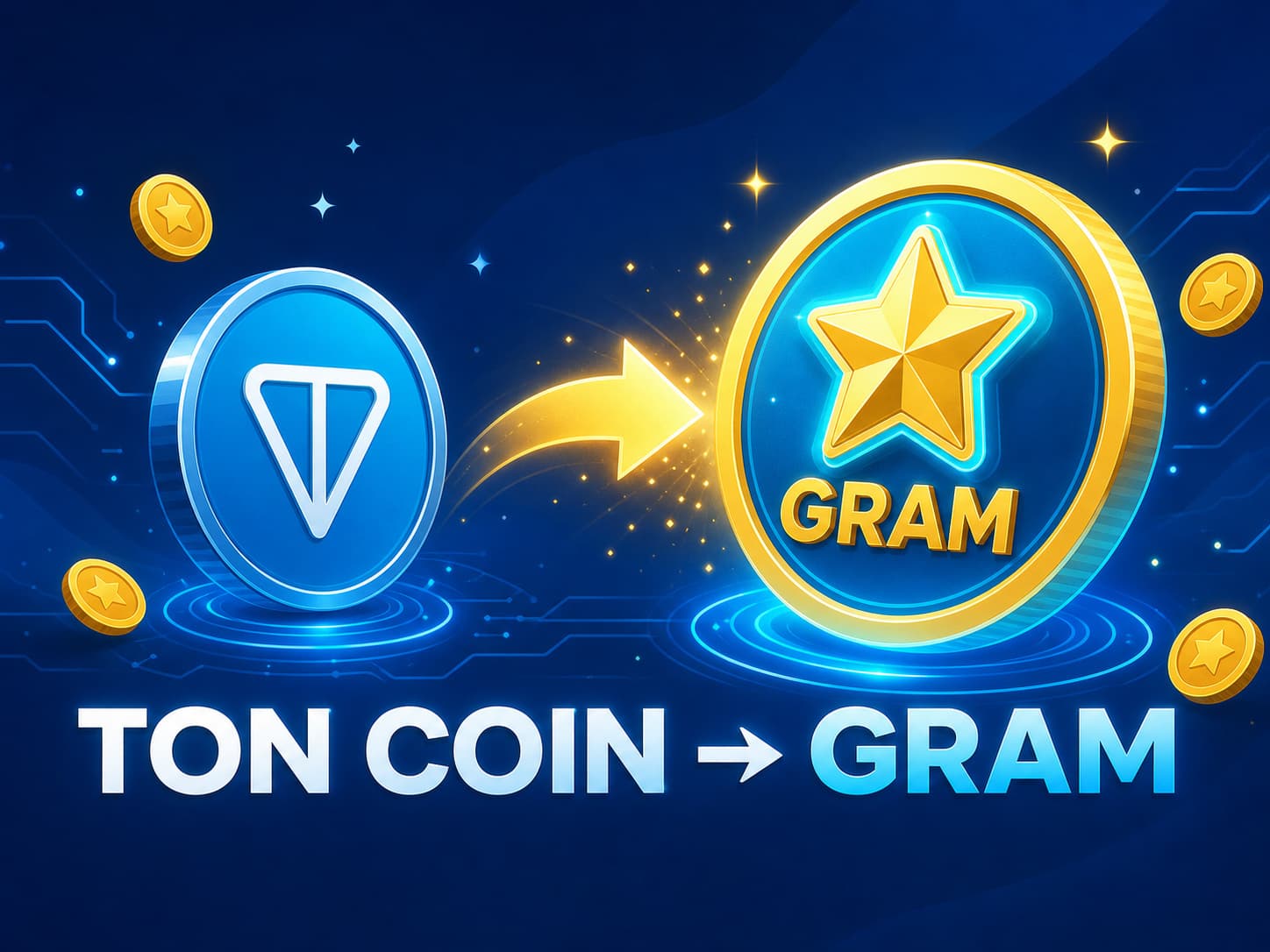

A ticker swap that moved markets, revived a name a regulator once forced off the table, and quietly confirmed who is really running the network now.
At 12:00 UTC on 15 June 2026, Toncoin stopped existing. In its place: Gram, ticker GRAM. Nothing else about the underlying network changed at that moment — no fork, no new chain, no migration for holders to perform. And yet the announcement moved prices, filled crypto press for a week, and put a name back into circulation that a US regulator had spent years trying to keep off the market. Read past the headline and two very different misreadings are on offer: assuming this is meaningless because nothing technical changed, or assuming you need to act because your token's name did. Neither is right, and working out why is more interesting than either.
What's changing
Token name, ticker, and logo
The change itself is narrow. Toncoin's name, ticker, and logo became Gram and GRAM. That's it, structurally. The Open Network — the blockchain that Toncoin ran on — kept its own name throughout.1 The rebrand's own framing, as reported by CoinMarketCap's Academy coverage, is explicit about separating the two identities: the network is called one thing, the asset that moves on it is now called another.1 Before this, "TON" did double duty as both the chain's name and the coin's informal name, which is part of why the split reads as tidying up rather than reinvention.
Exchange mechanics: the automatic 1:1 swap
For anyone actually holding the token, the mechanics were designed to require nothing. Crypto.com's own announcement is a clean illustration of how this worked across major exchanges: existing TON balances were converted to GRAM automatically, at a 1:1 ratio, with no action needed from the account holder.2 You didn't send anything anywhere. You woke up holding the same number of tokens under a new name.
Timeline: the vote, the cutover, and the transition window
The rename wasn't unilateral. A community governance vote ran in the days before the cutover and closed on 8 June 2026 with 81.22% of participating voting power in favour.3 The ticker itself switched at 12:00 UTC on 15 June 2026.3 Exchanges didn't all flip the switch on the same day — the rollout was phased between 9 and 22 June 2026, and platforms were encouraged to display both names side by side (typically "Gram [prev. Toncoin]") for a three-month transition window, so the old name didn't just vanish overnight from every interface a user might see.3 Crypto.com, for instance, kept TON-labelled trading and withdrawals open until 24 June 2026 before retiring the old ticker entirely.2
What's staying the same
The blockchain itself: still "The Open Network"
The point that got lost in most of the coverage is the one worth holding onto: the blockchain did not rebrand. It's still called The Open Network, still abbreviated TON, and nothing about the rename touched that name.1 Only the currency that runs on it changed its label. If you think of TON as the country and Toncoin as its currency, this was a currency redenomination, not a change of country.
Balances, wallets, smart contracts, consensus
Nothing about how the network actually works moved. Consensus mechanics, validator set structure, wallet addresses, and deployed smart contracts carried on exactly as before the cutover — none of that machinery has any concept of "Toncoin" versus "Gram" baked into it; it just tracks a native asset, and that asset's display name changed at the wallet and exchange layer, not the protocol layer. Retail coverage of rebrands routinely blurs this distinction: a name change at the interface is not a relaunch of the thing underneath it. Here, the two were kept genuinely separate — which is also why the automatic 1:1 conversion described above was even possible. You can't losslessly auto-convert a token into a genuinely new one; you can trivially relabel the same one.
Why "Gram," why now
The SEC's ghost: from a $1.7B raise to a shutdown to a voluntary revival
Here's the part that deserves more scrutiny than it got. "Gram" is not a fresh name Telegram invented for this moment — it's the original name of the token Telegram tried to sell between 2018 and 2020, a sale that raised roughly $1.7 billion before the US Securities and Exchange Commission stepped in and blocked it as an unregistered securities offering. Telegram ultimately settled, returning more than $1.2 billion to investors.1 The project that eventually launched, rebuilt by outside developers rather than Telegram itself, took the name Toncoin specifically to distance itself from that history. Six years later, the name the SEC effectively drove off the market is back, and this time it wasn't imposed by Telegram — a community vote approved it, with over 81% support.3
Organisations do not usually do this. A name attached to a regulatory shutdown is normally the one thing you retire for good, on the theory that reviving it just reopens old questions. Choosing to bring "Gram" back regardless is a statement, not an oversight — it reads as Telegram signalling that it no longer sees the SEC-shaped shadow over that name as a liability worth avoiding. That confidence cuts both ways: if regulators or wary users read the revival as tone-deaf rather than assured, the same history that's meant to signal strength could just as easily remind people why the name disappeared in the first place. Whether that confidence is earned is a separate question; that it's a deliberate choice, not a nostalgic accident, is the part worth noticing.
Telegram's expanding role: from outsider to largest validator
The rename also lands next to a governance shift that's easy to miss if you're only reading it as a marketing story. Telegram is not just cheering this on from outside — reporting around the change describes Telegram becoming the network's largest validator and the "primary driving force" behind TON going forward.3 That's a materially different relationship than the one Telegram has had with the network since 2020, when it was legally barred from operating it directly and the project continued under independent, community-run stewardship. A name that once belonged to Telegram, lost to a regulator, rebuilt by a community, is now returning to circulation at the same moment Telegram is taking the most consequential technical role in the network it doesn't formally own. Read that way, the rebrand isn't really the headline. It's the visible part of a bigger repositioning.
Where this fits in Durov's roadmap
The "Make TON Great Again" plan, and what's still undisclosed
Pavel Durov has framed this rename as one step within a broader, multi-step plan for the network, publicly referred to as "Make TON Great Again."1 Earlier steps in that push reportedly included network upgrades aimed at higher throughput and lower fees, alongside a steadily increasing operational role for Telegram itself.1 What the remaining steps actually involve hasn't been laid out in detail publicly, and speculating about them isn't something this piece is going to do — the honest answer, as of this writing, is that Durov has signalled there's more coming without specifying what.
Market reaction, and what it actually signals
By the normal logic of crypto rebrands, this should have been a non-event at best, or a mild red flag at worst — cosmetic-only renames are, more often than not, associated with low-substance relaunches that experienced holders learn to treat with suspicion. That's not what happened here. The announcement coincided with a sharp move upward in price and a large jump in trading volume, the kind of reaction usually reserved for news with real technical or financial substance behind it. A rename with zero protocol changes trading like a fundamental catalyst is the counterintuitive part of this story — and it only makes sense once you stop reading it as a cosmetic update and start reading it as a signal about who now runs the network and how seriously they intend to be taken. Markets, in this case, appear to have priced the governance story, not the font change.
What you need to know (practical takeaways)
If you're holding TON, you don't need to do anything — your balance converted automatically to GRAM, at 1:1, without any action on your part, on whichever exchange-specific date your platform completed its rollout.2 If you're reading contracts, documentation, or third-party integrations that still say "TON" or "Toncoin," don't assume they're wrong or out of date; expect that language to persist for a while, since the network's own name genuinely hasn't changed, only the currency's has. The ticker is the least important part of the story. The part worth remembering is that Telegram just became the network's largest validator under the one name it was once forced to abandon.
Sources
- CoinMarketCap Academy — Toncoin Rebrands as Gram in Return to Original Name (June 2026) ↩a ↩b ↩c ↩d ↩e ↩f
- Crypto.com — Crypto.com Supports the Toncoin (TON) Rebranding to Gram (GRAM) (17 June 2026) ↩a ↩b ↩c
- AMBCrypto — TON officially rebrands Toncoin to Gram as Telegram deepens role in network (9 June 2026) ↩a ↩b ↩c ↩d ↩e